Changing the conversation
Mary Evans uses behavioral finance to bring financial planning down to earth.
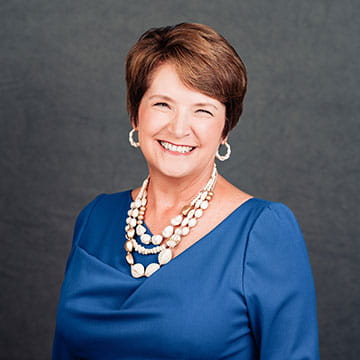
Meetings with Mary Evans and her team look a little different than what one might expect from a Raymond James Chairman’s Club-level financial advisor. There’s no big oak desk or presentation filled with intricate charts and graphs. Instead, she and her clients sit in comfortable recliners gathered around a coffee table in a space that feels more like a home than a business office.
“I’m bringing the temperature down and making people feel comfortable,” she says. “I jokingly like to say, ‘If you’re not looking forward to meeting with your financial advisor, you have the wrong financial advisor.’”
Boardroom origins
Mary’s sitting-room approach could seem at odds with her corporate roots. Before becoming a financial advisor, she held multiple leadership roles at major companies, including vice president of finance at Rodale Publishing. When she started her advisory business, she fully intended to leverage the same strategic thinking and in-depth analysis she was used to – only this time to help families and individuals with their personal finances. However, that approach didn’t have the effect she was hoping for.
“I was showing people graphs like I was in the boardroom and looking at their faces thinking, ‘Oh, they hate this,” she recalls. “As I talked to my clients more, I realized what they were really driven by were the emotions they had around their money. I thought, ‘I can show you facts and numbers until the cows come home, but that’s probably not going to change your behavior and it’s certainly not going to help you sleep at night.’”
Going deeper
Mary realized she needed to find a way to speak to these underlying emotions while framing her work in a language her clients could actually understand. Fascinated by neuroscience and psychology, she started drawing on these concepts to develop a behavioral finance approach well before behavioral finance was the recognized field it is today.
“My focus in everything I do is to help my clients feel comfortable talking about their money with me and implementing the plan we’ve agreed on,” she says. “Understanding the financial markets is important, portfolio theory is important, but if you abandon your long-term plan at the first sign of a market downturn, none of that matters. You can’t get ahead by making emotional, fear-based decisions.”
Calm during crisis
It can be incredibly difficult for investors to stay the course in turbulent times, and Mary witnessed this firsthand when the 2008 market crashed just weeks after she opened her advisory business. Despite feeling daunted by what it could mean for her business, Mary dove right into the fray. She began hosting a seminar titled “Laid Off and Looking for Answers,” geared toward helping people navigate sudden unemployment amid plummeting stock prices.
“I met so many people who we’re getting ready to sell out and I’d say, ‘Please don’t. Let us walk you through this.’ And that’s what we did. It ended up being the biggest time for growth my business has ever had.”
Through her seminars, presentations and hand-holding with all her new clients, Mary was able to convince nearly all of them to stay invested through the recession. She would go on to make Chairman’s Club in just 10 years, without ever paying for advertising.
FOMO vs. FORO
Mary’s initial work with clients during such a stressful financial climate proved early on for her the absolute importance of taking a more personal, down-to-earth approach with her clients. She began focusing on uncovering the deeper emotional drivers of their relationships with money, or what she calls their “Money Why.”
Mary believes everyone either has FOMO, a fear of missing out, or FORO, a fear of running out. To uncover which one applies to each of her clients, she asks them her three magic questions:
- How long have you owned your home?
- Do you have credit card debt that you don’t pay off at the end of each month?
- How long do you keep your cars?
From their answers, Mary and her team get a good sense of how their clients spend or save their money – whether they get a thrill from shopping, hoard savings out of fear, or something in between. The Money Why that’s revealed helps to guide their conversations and the strategies they implement, all with the aim of helping them achieve more peace with their finances.
“My definition of financial happiness is this: you have enough money to buy the things that give you pleasure today, while knowing your financial future is sound,” she says.
Dropping the shame
Mary’s drive to help people have better relationships with their money extends far beyond her own practice. It inspired her to write her book, “Emotionally Invested,” which serves as a roadmap to a better financial life that anyone can access.
“I had seen how effective our behavioral finance approach was in our own practice and I wanted to create something that would help more people have the financial conversations they desperately need to have,” Mary says.
A key component in this work, she believes, is dropping the shame in our global conversation around money.
“This is my analogy: I know how many calories are in a brownie. And yet, when I'm having a really bad day, guess what? I'm going to eat a brownie. And if you yell at me for eating a brownie, I'm going to eat two brownies.”
Fortunately, Mary’s message is catching on in a big way. Her book became a bestseller on Amazon, and she recently recorded a segment for “All Access with Andy Garcia,” which will air later this year and captivate audiences on numerous public television stations nationwide.
“My mission is to change the conversation that we have in this country around money.”
Membership is based on prior fiscal year production. Requalification is required annually. The ranking may not be representative of any one client’s experience, is not an endorsement, and is not indicative of an advisor’s future performance. No fee is paid in exchange for this award/rating.